Having an erratic fuel gauge on Nissan X-Trail T30 or T31 is not uncommon. It’s a widely discussed issue on many Nissan and X-Trail Owners’ online platforms.
Simply put, this problem is usually caused by a faulty or worn-out in-tank fuel sending unit, damaged wiring connections at the vehicle’s instrument cluster, or a dual sender communication error.
Most owners complain of the fuel gauge fluctuating between “Empty” and “Full” while driving. Sometimes, the fuel gauge will show “Full” after refueling at a gas station, then suddenly drop to “E.” In rare cases, the needle will be stuck on “Empty” or “Half” on the dashboard.
Common Causes of an Erratic Fuel Gauge on Nissan X-Trail T30

If you are experiencing erratic behavior from your Nissan X-Trail T30, it’s important to note that it won’t be a quick fix. To solve this problem, you might be forced to either remove the fuel pump assembly or deassemble the dashboard fuel cluster.
Faulty Fuel Sending Units (Inside the Tank)
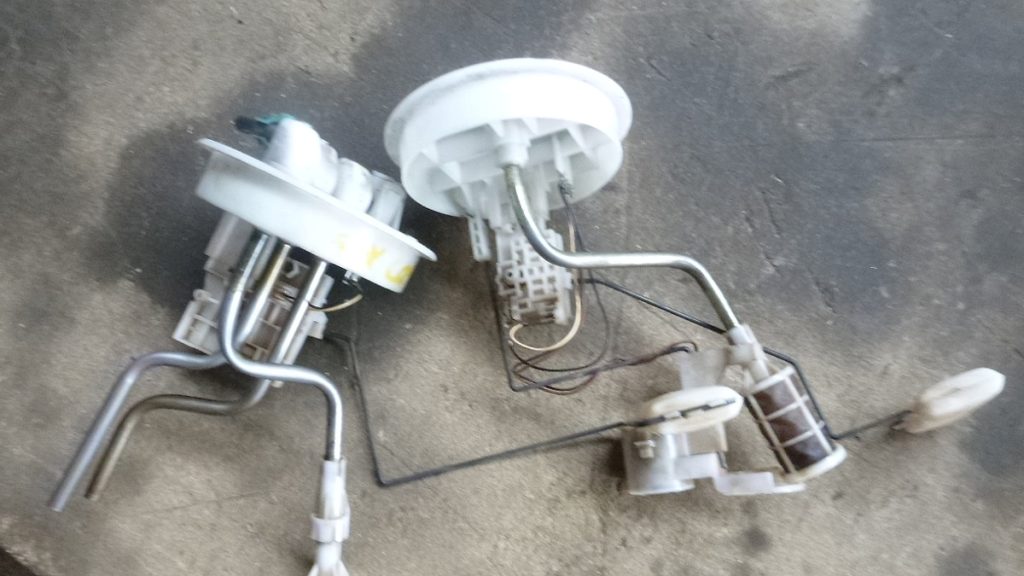
The Nissan X-Trail T30 uses a fuel sending unit that’s located inside the tank. Additionally, the T30 X-trail tank has an irregular shape; as a result, it features two separate fuel sending units. One is located on the passenger side, and the secondary sender is on the opposite side.
Since the float arms on the sending units run along serrated contact points, the resistance strips corrode or wear out over time, resulting in inaccurate readings on the vehicle’s dash. Furthermore, the plastic clips that hold the floats’ boom arm to the resistor strip may detach or wear out with age, causing the gauge to stick or bounce at specific marks (Empty or Half marks).
This is usually the most common cause of an erratic fuel gauge in a Nissan X-Trail T30 or T31. And you’ll often notice that symptoms worsen after refueling or when the fuel level is low.
Wiring Issues Behind the Instrument Cluster
In case there is a loose connection behind the cluster, it may interrupt the signal, leading to erratic fuel readings. Sometimes, corrosion or damage to the wires and connectors can also lead to unstable readings.
If your X-Tral has poor or loose grounding, it may also cause the needle to behave unusually.
Most of the time, vibrations and vehicle age can contribute to connector problems. Some owners will notice the issue worsens while driving on rough roads.
Dirty Tank Contaminants
On older vehicles, dirt, sludge, rust, or sediment can accumulate in the fuel tank around the sensor float over time, restricting the float arm’s mechanical movement. Contaminants can also cause the float arm to stick.
Water contamination in the fuel tank can accelerate corrosion, forming sediments that restrict the float arm’s movement. These cases are prevalent in vehicles that sit unused for long periods, leading to sediment buildup.
How to Diagnose
Before ordering replacement parts, it is recommended that you first check your cluster wiring. Wiggle the connector behind the dashboard and watch for any changes on the fuel gauge. Also, clean the wiring leading to the fuel tank pods under the rear seats.
Use an OBD II scanner to check for fuel level sensor or communication faults. It’s essential to note that some of these faults might not trigger a check engine light.
If you are comfortable being hands-on and technical, pull both fuel sender units, inspect the resistor boards, and check for loose float arms (movement, sticking, or binding). Resistors can be tested with a multimeter to verify that their voltage drop is uniform as the float moves.
Also, check for rust, sludge, or debris. If you spot any contaminants in your X-Trail T30 fuel tank, clean it. Replace clogged fuel filters if necessary. It is important to note that this exercise requires some hands-on technical automotive knowledge. Therefore, it is best done by a certified and professional mechanic.