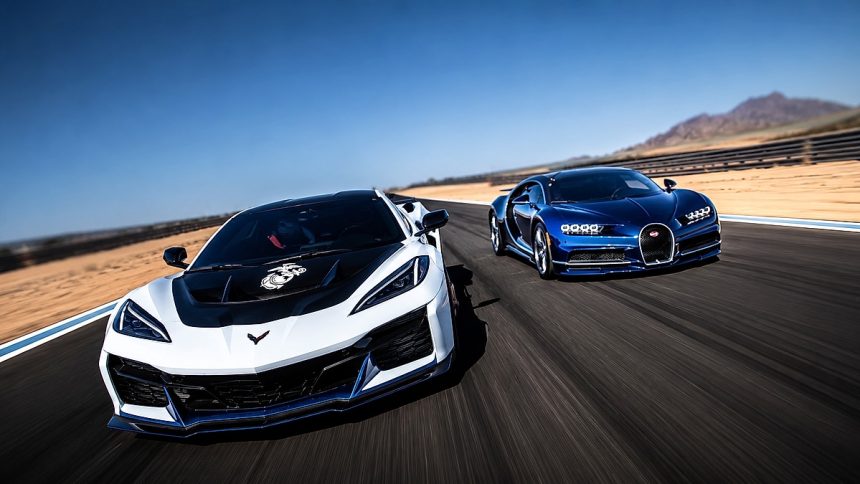
Something remarkable recently happened at Apex Motor Club in Arizona. A $230,000 Chevrolet Corvette ZR1X defeated a $4 million Bugatti Chiron in a series of drag races. The showdown, organized by DragTimes YouTube channel host Brooks Weisblat, has sparked massive debate across automotive forums, podcasts, and news websites.
If you’ve read the earlier piece by my colleague Victor Waweru, then you know the Corvette ZR1X did the unthinkable by beating the Chiron not once, but three times. We are clearly living in a different era of performance cars. Corvettes are now taking out multimillion-dollar hypercars.
But that raises an even bigger question. How did Chevrolet’s so-called “poor man’s Ferrari” manage to overpower one of the most advanced hypercars ever built?
Brute Force Vs. Hybrid Precision

Here’s the truth. This wasn’t just a lucky break for American engineering; it was a masterclass in how usable acceleration and superior launch management can beat raw horsepower. On paper, the Bugatti Chiron entered the race track as the heavy favorite.
The French-engineered hypercar packs a massive 8-liter W16 engine equipped with a quad-turbocharger, churning out a staggering 1,479 hp and 1,180 lb-ft of torque. Channeling that power to the wheels is an all-wheel-drive system and a seven-speed dual-clutch transmission designed to propel the Bugatti to a top speed of 261 mph.
The Corvette ZR1X, on the other hand, represents a different school of thought. It features a 5.5-liter twin-turbo flat-plane-crank V8 (LT7) paired to a 400-volt electric motor (driving the front wheels). This hybrid configuration produces a combined 1,250 horsepower, a deficit of over 200 horsepower compared to the Bugatti Chiron.
But here’s where the tables turn on the Chiron: the ZR1X has a significant advantage in weight and torque delivery. While the Bugatti Chiron is a heavyweight grand tourer, the ZR1X is a lighter, more agile weapon, optimized for the mid-engine C8 platform. The electric front axle delivers instant torque to fill the gaps where traditional turbochargers might hesitate off the line.
Tiny Ball Bearing Effect (Environmental Factors)

A lot of hypercar aficionados are salty over the showdown at Apex Motor Club, and their displeasure is warranted. For starters, the drag race was not held on a professionally prepped strip but on a private, closed-circuit track in 80-degree Arizona heat.
These “real-world” conditions played a decisive role in the outcome. The racing surface was covered in fine dust that acted like “tiny ball bearings” under spinning tires, which made traction the ultimate commodity.
As expected, under these conditions, Chiron’s massive power became its own worst enemy. During the standing starts, the Bugatti suffered from violent wheelspin, struggling to put its 1,500 hp to the pavement despite having an advanced all-wheel-drive system.
The ZR1X also fought for grip, but its hybrid-assisted launch proved more resilient. The electric motor on the front axle allowed the Corvette to “bite” into the surface and propel forward with a level of control the quad-turbo W16 could not match. While it seemed like the Bugatti was in “real-time slow-mo” fighting for traction, the Corvette shot off as if the video was on “X2.”
Superior Launch Management and Repeatability
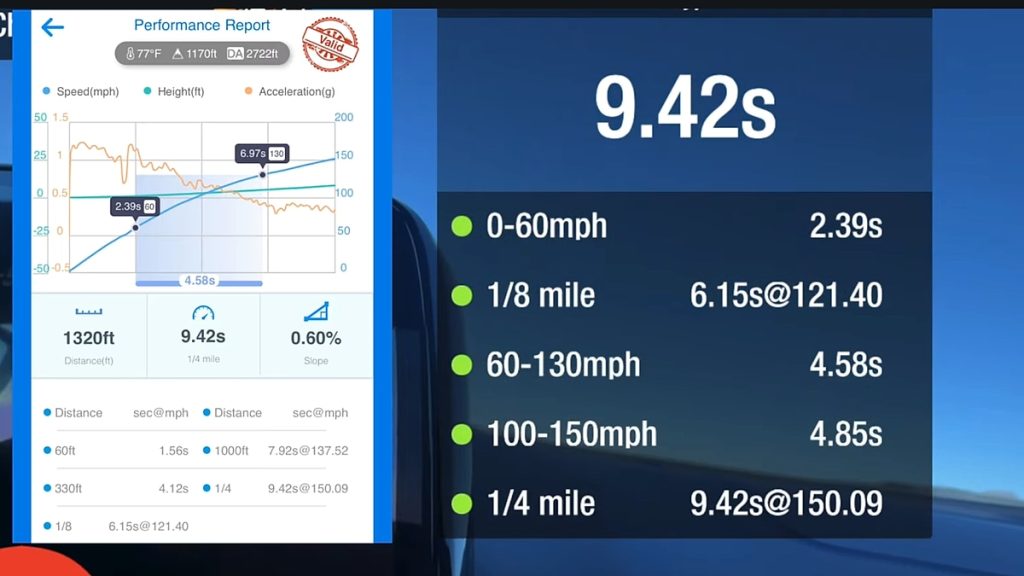
One of the most critical reasons behind the Corvette’s victory was its impressive launch management. Chevrolet’s engineers designed the ZR1x to be a “repeatable result” machine, prioritizing consistent execution over theoretical spec-sheet dominance. This was evident by the fact that the ZR1X won all three consecutive drag races from a dig, even when the Corvette driver gave the Bugatti the “hit” headstart.
The data from the first race told a harrowing story for the hypercar world. The ZR1X recorded a 0-60 mph sprint in just 2.39 seconds on the unprepped surface and crossed the quarter-mile mark in 9.42 seconds at 150.09 mph. The Chiron, in comparison, did 0-60 mph at 3.28 seconds, nearly a full second behind the Chevy Corvette. The gap has been described by different reviewers as large enough to be measured with a “solar clock” or as wide as a “football field.”
Power Vs. Gearing (The Roll Race)

The only moment at the drag race where the Bugatti showed its true potential was during the initial roll race from 30 mph. By starting at a higher speed, the traction issues it had during the drag race were mitigated, allowing the Chiron’s sheer power and high-speed gearing to take over.
In the first round, the Bugatti took an arrow victory, though the Corvette driver noted a transmission mishap, where he manually selected too high a gear for the start. However, the Corvette’s adaptability was proven in the rematch. During the second roll race, the driver left the shifting entirely to the Corvette’s computers.
The ZR1X’s instant electric torque gave it the initial lead, and while the Chiron’s massive W16 began to close the gap at the top end, it wasn’t enough to overtake the American car before the finish line. The Corvette held its ground, proving that its hybrid powertrain is effective not just at a standstill but also during high-load acceleration.
The Corvette ZR1X is Officially a Hypercar Killer

The Corvette’s victory over the Bugatti Chiron represents a huge shift in the automotive world. For decades, Hypercars have been reserved for boutique manufacturers and featured seven-figure price tags, but the ‘democratization’ of speed is now in full swing.
At roughly one-fifth of the cost of the Bugatti, the ZR1X has exposed the reality that raw performance can now be engineered and scaled at a fraction of the cost of a conventional hypercar.
So, how did the Corvette win? Well, it stacked proven engineering solutions. A mid-engine layout for ideal weight distribution, an electric motor to eliminate low-end turbo lag, and electronics tuned to assist the driver rather than interfere.
As Chevrolet executive chief engineer Tony Roma noted, the brand’s first true hypercar matched “outlandish performance to assured control.” By humiliating one of the world’s most iconic speed machines on a dusty Arizona track, the 2026 Chevrolet Corvette ZR1X has officially assumed its place as the new apex predator of the performance world.
Corvette ZR1X just humiliated a $4 milllion Bugatti Chiron https://t.co/J0OGX5CeV7 #bugattichiron #corvettezr1x pic.twitter.com/qY0qnh2ps8
— Motindechu (@motindechu) May 24, 2026