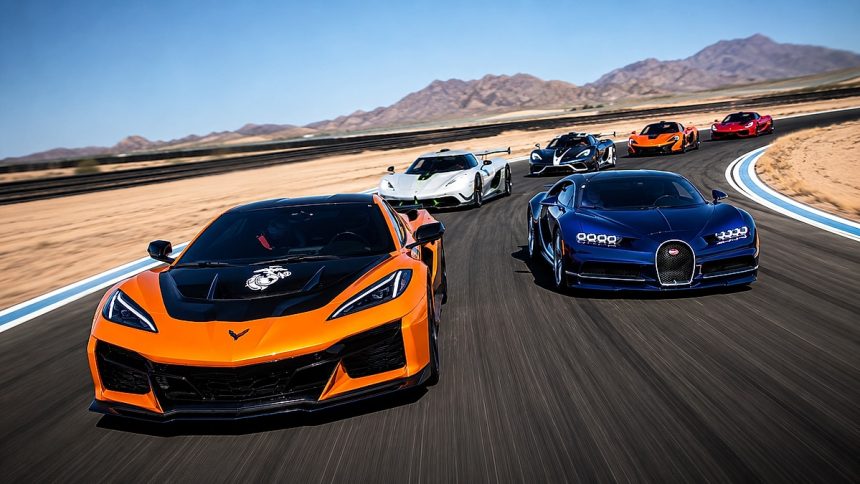
For the longest time, the automotive performance hierarchy has always been clear. If you wanted world-topping speeds, you’d have to spend seven figures on boutique European Exotics. The arrival of the 2026 Chevrolet Corvette ZR1X has completely changed that school of thought.
Backed by a 5.5-liter twin-turbo flat-plane-crank V8 and a high-output hybrid system, the ZR1X churns out a combined 1,250 horsepower. It is priced at approximately $230,000 and $250,000 and offers a ‘democratization’ of speed that has instilled fear in the hearts of the most exclusive names in the industry.
The following are five hypercars that the Corvette ZR1X can embarrass on the track and the drag strip.
| Vehicle | Horsepower | 0-60 MPH | 1/4 Mile Time | Notable Track Time (COTA) | Estimated Price |
| Corvette ZR1X | 1,250 hp | 1.68 – 1.89s | 8.67 – 8.99s | N/A | ~$230,000 |
| Corvette ZR1 | 1,064 hp | 2.3s | 9.6 – 9.8s | 2:13.00 | ~$183,300 |
| Bugatti Chiron | 1,479 hp | 3.28s* | 9.4s+* | N/A | $4,000,000 |
| Koenigsegg Jesko | 1,280-1,600 hp | ~2.5s | 8.9s+ | N/A | $3,000,000 |
| Rimac Nevera | 1,914 hp | 3.0s* | 8.25 – 9.7s | ~2:15.00 (Est) | $2,500,000 |
| Ferrari SF90 | 986 hp | <2.5s | 9.3s | ||
| McLaren P1 | 903 hp | <2.8s | 9.8s | 2:17.51 | $2,000,000+ |
*Note: The Performance figures on the above table for competitors often reflect “real-world” results from sources rather than the manufacturer’s ideal-condition claims.
Bugatti Chiron

The Bugatti Chiron is world-famous. It is the quintessential hypercar, featuring a quad-turbocharged W16 engine producing 1,479 horsepower. Despite having a massive power advantage and a $4 million price tag, the ZR1X recently proved it could school the French-engineered hypercar in a head-to-head showdown at the Apex Motor Club in Arizona.
In three consecutive drag races from a dig, the ZR1X humbled the Chiron, even when giving the Bugatti a “hit” headstart. The ZR1X’s primary advantage lies in its hybrid precision versus the Bugatti’s brute force. While the Chiron struggled with violent wheelspin on the unprepped surface, the Corvette’s 400-volt electric motor on the front axle allowed it to “bite” into the pavement.
The result was a 0-60 mph time of 2.39 seconds for the Corvette, while the Chiron lagged behind at 3.28 seconds. The ZR1X’s lighter weight (about 1,000 pounds less than the Bugatti) and superior launch management made it more effective in real-world conditions.
Koenigsegg Jesko
The Koenigsegg Jesko, like the Chiron, is a seven-figure hypercar ($3 million). It’s a Swedish marvel designed for extreme speed. But even with its advanced performance specs, the ZR1X during a showdown proved that usable acceleration often trumps theoretical capability.
The Corvette finished the quarter-mile in the high-eight-second range, outpacing the Jesko in that specific run. The result was disruptive, considering the mass-produced American car was built as a hand-built hypercar costing fifteen times as much.
What made the ZR1X victorious was its repeatable performance. While most hypercars need the perfect conditions to achieve their advertised numbers, Chevrolet engineered the ZR1X to launch hard and stay planted run after run. Thanks to its mid-engine layout (ideal for weight distribution) and electric torque to cater for turbo lag, the Corvette delivers brutal acceleration from a standstill that the more high-strung Jesko struggles to match in a short sprint.
Rimac Nevera

On paper, putting a 1,250 hp mass-produced car against a 1,914 hp quad-turbo hypercar puts the Rimac Nevera at a higher ground. However, real-world testing by The Hamilton Collection showed the ZR1X “hanging with” the electric titan.
In an unprepped environment, the Nevera’s massive power came to its disadvantage, requiring a full 3 seconds to hit 60 mph, well off its “perfect conditions claim. The ZR1X, on the other hand, used its advanced traction management to stay competitive, covering the quarter-mile in a time that rivaled that of the $2.5 million EV.
The Corvette ZR1X’s advantage here is efficiency of execution. While the Rimac is a “battery-electric cheat code,” its performance is highly dependent on the mode configurations and surface prep. The ZR1X offers comparable straight-line pace without the astronomical pricing or the complexity of a four-motor EV system. For buyers, the fact that a $250,000 car can stay within striking distance of an 8.25-second car like the Nevera makes the Rimac’s 10X valuation difficult to justify based on performance alone.
McLaren P1

The McLaren P1 defined the hypercar era of the 2010s. With its 903-horsepower hybrid powertrain and carbon-fiber tub, it was designed to be the ultimate track weapon. However, the arrival of the C8 platform has shown that “new-age supercar performance” can now be had for a fraction of the P1’s seven-figure price tag.
During the Circuit of the Americas (COTA), the bone-stock Corvette ZR1 (1,064 hp predecessor) officially stripped the P1 of its track prestige. During testing at COTA, the stock ZR1, equipped with the ZTK track package, clocked a lap time of 2:13 seconds. This performance alone was enough to humiliate the McLaren P1, which previously recorded a lap of 2:17.51 seconds on the same course. The fact that the mass-produced Chevrolet was 4.5 seconds faster than a limited-edition hybrid hypercar costing about ten times as much has redefined the “working-class” of the automotive scene.
The ZR1 comes with advanced aerodynamics and a massive 5.5-liter twin-turbo flat-plane crank V8. While the P1 relies on early-generation hybrid tech. The Corvette uses modern suspension tuning and downforce to maintain higher speeds through the technical corners. With the ZR1X featuring even more 1,250 horsepower and an electrified front axle for better corner-exit, the gap between America’s flagship and the aging British legend is expected to grow even wider.
Ferrari SF90 Stradale

The Ferrari SF90 Stradale is a technological tour de force, but even in modified form, it struggles to shake off the Corvette. In drag races between the stock ZR1 (1,064 hp predecessor to the ZR1X) and a tuned 1,200 hp SF90, the cars ran neck-and-neck, both recording 9.3-second quarter-mile passes.
If the standard rear-wheel-drive ZR1 can challenge a tuned Ferrari hybrid this hard, the ZR1X, with its additional electric front-axle boost and 1,250 hp, is set to dominate the Italian flagship.
The ZR1X’s advantage comes from its superior power-to-weight ratio and track pedigree. While the SF90 relies heavily on hybrid spikes for initial acceleration, the Corvette’s twin-turbo LT7 V8 provides more consistent top-end pull. Furthermore, the Corvette platform has already proven superior on the track. The ZR1 recorded a 6:50.763 Nurburgring lap, significantly faster than the SF90’s estimated 7:00- 7:03 times. The ZR1X’s added hybrid grip only widens this gap.